
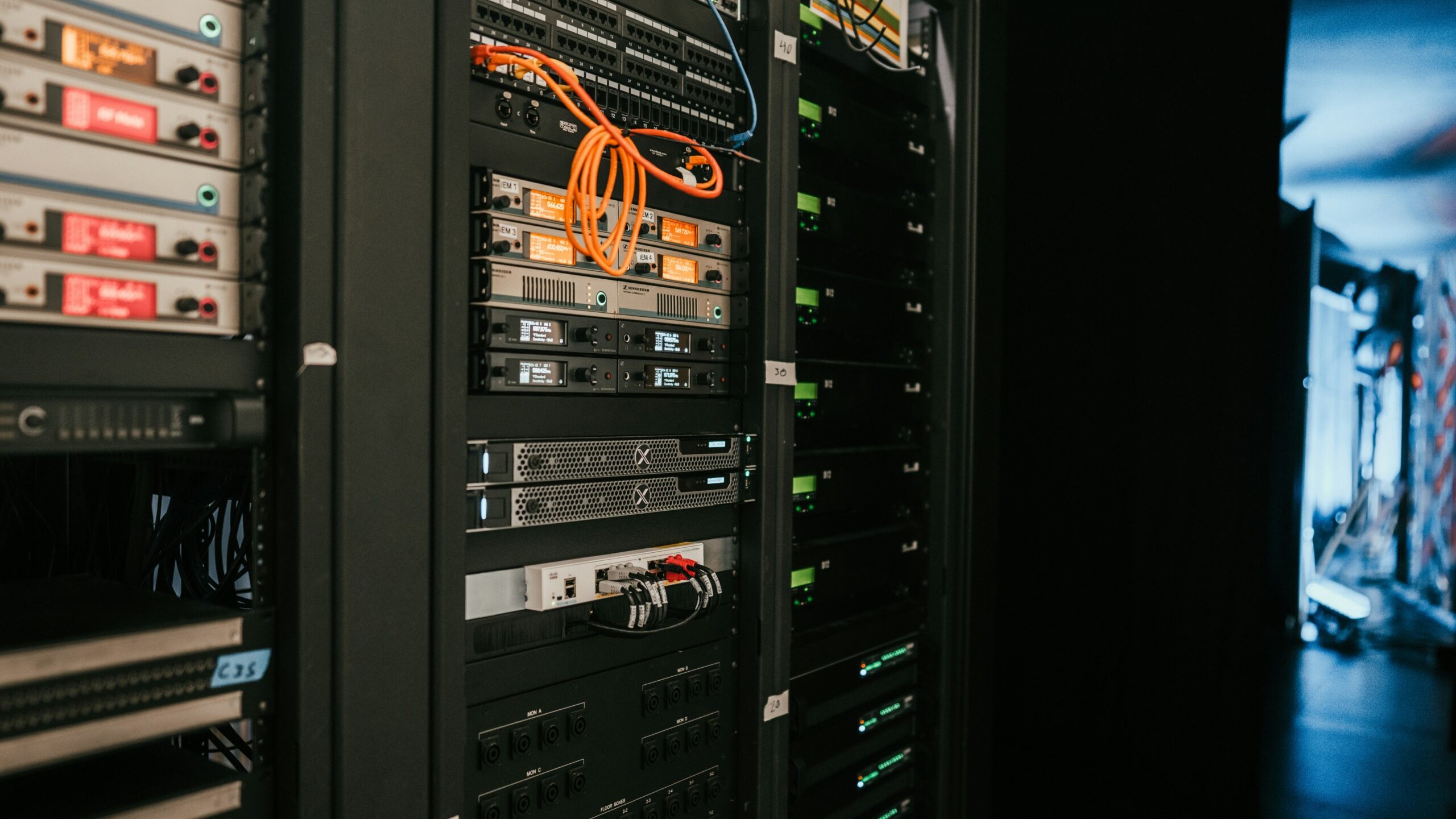
The match you watch is not produced at the stadium. Every camera and microphone feed is shipped live, down three separate fibre lines, to one control centre hundreds of miles away, and the entire feed travels the distance twice, over two physically different paths, so that a single cut cable can never take the broadcast down. This is the actual network behind a World Cup match, based on an on-site look at the tournament’s International Broadcast Center by networking educator NetworkChuck.
Every World Cup match is played at a stadium, but it is not produced there. It is produced at the International Broadcast Center, or IBC: a single building, hundreds of miles from most of the stadiums it serves, where every camera angle is colour-graded, every replay is cut, every graphic is added, and the world feed is assembled before it ever reaches a broadcaster.
This is a relatively recent change. The last time the IBC for this tournament was in the same city, back in 1994, production was mostly done on site at each stadium: its own colour team, its own replay team, its own audio team, stadium by stadium. According to Christophe Barbieux, head of broadcast infrastructure for host broadcaster HBS, centralising those roles was about consistency: fewer, better-trained teams working every single match, instead of a full production crew repeated at every venue.
Every stadium in the tournament is connected to the IBC by three separate 200 Gbps fibre connections, each one routed along a physically different path. The reason is blunt: fibre cuts happen, often enough that the network is designed around them happening mid-match, not as a rare edge case.
Of the three connections, two are active at all times and the third sits ready as a spare. But the two active paths are not a simple primary-and-backup pair either. Every single camera and audio feed is sent twice, as two identical copies, one down each of the two active paths. Engineers on the network refer to them simply as the red stream and the blue stream. Whichever copy of a given packet arrives first is the one that gets used; the duplicate is discarded. Neither copy is a passive backup sitting idle. Both are live, all the time, and the receiving system is simply built to prefer whichever one shows up first.
The point of the exercise is stated plainly by the engineers who run it: failure is not an option. A single fibre cut, which the crew filming on site witnessed happen in real time during the tournament, should be invisible to a viewer at home.
A single match can involve upwards of 45 cameras, more for the final. Each one, doubled for redundancy, needs to reach every broadcaster who wants it: Fox, Telemundo, the BBC, NHK and dozens of others, potentially over a hundred separate broadcast organisations for one match. Sending a separate copy of every camera to every broadcaster individually would multiply the load past what any network could carry.
The network solves this with multicasting: a camera at a stadium sends exactly one stream into the network, and the network itself, not the camera, duplicates that stream to every destination that has asked to receive it. At any given moment during the tournament the network is managing around 150,000 of these multicast flows. The switching hardware doing this is a mix of Cisco Nexus and Arista switches, controlled by a purpose-built software platform (referred to on site as TFC) that talks to the switches over gRPC and calculates, stream by stream, a genuinely separate physical path for the red copy and the blue copy of every feed, so the two are never one fibre cut away from both failing together.
Because the entire broadcast runs as a live computer network, it can be captured and inspected exactly like any other network traffic, and the crew behind the video obtained a real packet capture from an actual match to do exactly that. A few things stood out.
The video travels uncompressed: no codec, nothing resembling the MP4 or H.264 file most people are used to. It is transmitted under a broadcast-industry standard called SMPTE ST 2110, built specifically for sending professional-quality, uncompressed video and audio over an IP network rather than dedicated broadcast cabling. In the captured sample, a single second of 1080p video at 59.94 frames per second worked out to roughly 5.2 gigabits per second, all of it raw pixel data split across hundreds of thousands of individual network packets, arriving in duplicate exactly as described above: matching sequence numbers, matching timestamps, sent to two different destination addresses on two separate networks.
| Metric | Figure |
|---|---|
| Fibre connections per stadium | 3, each 200 Gbps, on physically diverse paths |
| Active paths in simultaneous use | 2 of the 3 (each feed duplicated across both) |
| Cameras per match | 45 or more (up to 50 for the final) |
| Multicast flows on the network | ≈150,000 at once |
| Bitrate of one uncompressed 1080p feed | ≈5.2 Gbps |
| Matches the IBC can produce simultaneously | 6 |
Everything above happens before a broadcaster even has the finished feed. Getting it from the broadcaster to viewers everywhere is a separate infrastructure problem, and reporting on exactly this challenge for the 2026 tournament points to the same answer used across most of the streaming industry: broadcasters do not typically build this themselves. They colocate inside neutral, third-party data centres, such as those run by Equinix, that already have direct connections to internet service providers (ISPs), network service providers (NSPs), content delivery networks (CDNs) and the major cloud platforms, all in one building. That means one connection into the data centre effectively reaches all of them, instead of negotiating and wiring a separate direct link to every single partner.
Based on ITBrief’s reporting on Equinix and the 2026 World Cup.
Inside that data centre, broadcasters generally run a hybrid of colocation and cloud rather than picking one. High-quality video masters stay on hardware the broadcaster physically controls, in a private cage, while a much smaller, low-resolution proxy copy goes to the cloud for fast, flexible editing. Once the edit is finished, only a small instruction file describing what changed, not the video itself, gets sent back, and those same edits are then applied to the original high-quality master locally. The large files never actually have to leave the broadcaster’s own infrastructure, which keeps both editorial control and cloud data-transfer costs down.
Every stadium keeps a scaled-down version of the IBC on site anyway, on what staff on location literally call Tech Street, even though none of it is used for a normal match. It exists purely for the scenario where all three fibre connections to the IBC fail at once: a colour team, a replay team and an audio team, ready to produce the match locally instead of at the IBC.
If it comes to that, a satellite truck parked at the stadium can transmit the world feed directly to broadcasters, bypassing the fibre network and the IBC entirely, or relay the signal back to the IBC by satellite if the IBC itself is still reachable that way. The goal stated by staff on site was simple: the match reaches the world no matter what happens to the fibre.
Two smaller details from inside the IBC are worth knowing. The match ball itself contains sensors that measure things like kick velocity, feeding a live on-screen tracker of ball movement and strike strength, and the ball charges wirelessly between matches. Pitch-side microphones pick up the sound of the ball being struck, and the audio system automatically boosts the gain on whichever microphone the ball is currently closest to, rather than a person manually riding the fader as was done in earlier tournaments.
Separately, commentary audio from broadcasters typically reaches the IBC faster than the video does. Left uncorrected, a commentator could call a goal before it appears on screen for viewers at home. Engineers at the IBC deliberately delay the audio to keep it synchronised with the picture, a detail that has nothing to do with cameras or fibre, but matters just as much to what viewers actually experience.
Perhaps the most striking fact about the entire network is that none of it is permanent. The IBC, the portable data centre at every stadium, the fibre connections, the switching fabric carrying 150,000 multicast flows: all of it is built from scratch in roughly four months ahead of the tournament, and dismantled within four to six weeks of the final. One of the most demanding live networks in the world runs for one tournament and is then taken apart completely.
Not the stadium. Every camera, microphone and replay feed is sent live to a central International Broadcast Center, where the entire world feed is produced, then distributed to broadcasters. See why the game is not made at the stadium.
Each stadium has three separate 200 Gbps fibre connections on physically different paths, with every camera and audio feed sent twice across two of them simultaneously. A single cable cut is designed to be invisible to viewers. See the full explanation.
Two connections carry duplicate copies of every feed at all times, and the third is a spare. Fibre cuts happen often enough during a tournament that the network is built assuming they will happen, not hoping they will not.
No. Inside the broadcast network the video is uncompressed, transmitted under the SMPTE ST 2110 standard for professional media over IP, rather than a codec like the ones used for streaming video. See what the picture looks like as data.
Multicast lets a camera send a single stream into the network, which then duplicates it to every broadcaster who wants it, rather than sending a separate copy to each one individually. With dozens of broadcasters wanting the same 45-plus camera feeds, that difference is what keeps the network usable. See the full explanation.
Every stadium keeps a scaled-down production team and equipment on site for exactly this case, plus a satellite truck that can send the match directly to broadcasters or relay it back to the IBC by satellite. See the stadium’s backup plan.
The Hardvance Team is the editorial team at Hardvance, a UK computer and electronics retailer based in Mildenhall, Suffolk. We build and upgrade PCs and sell laptops, phones, networking gear, monitors and printers, and our guides cover the same ground. Every guide names its sources and explains how we checked the figures, and we say plainly when something is our opinion rather than a tested result.
View all posts by Hardvance Team


No account yet?
Create an Account