
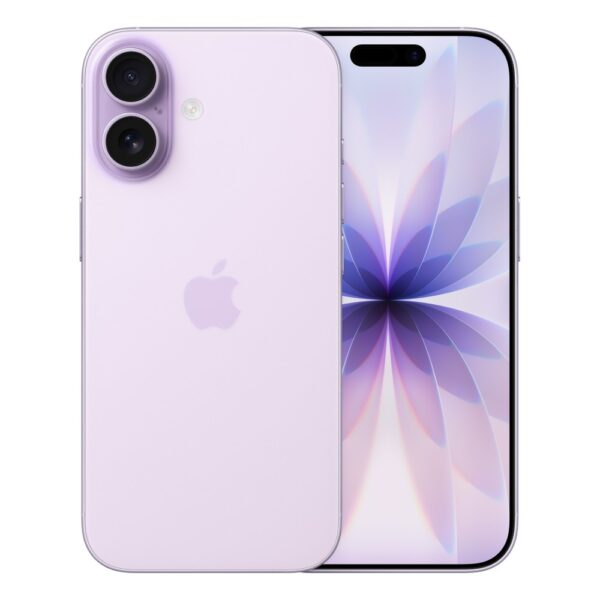
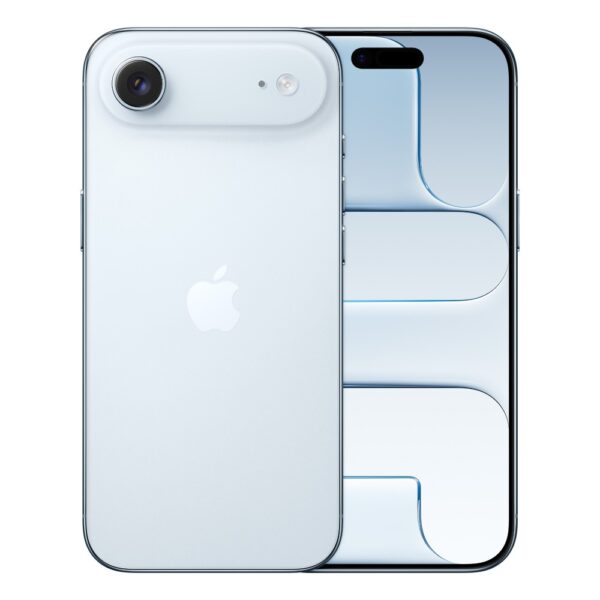
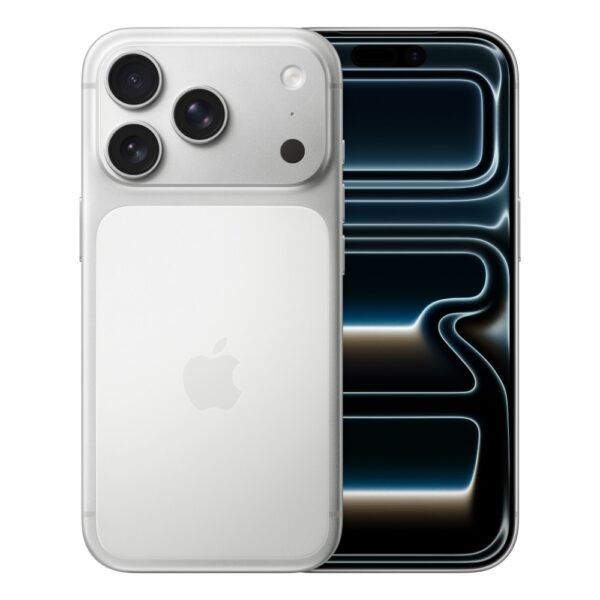

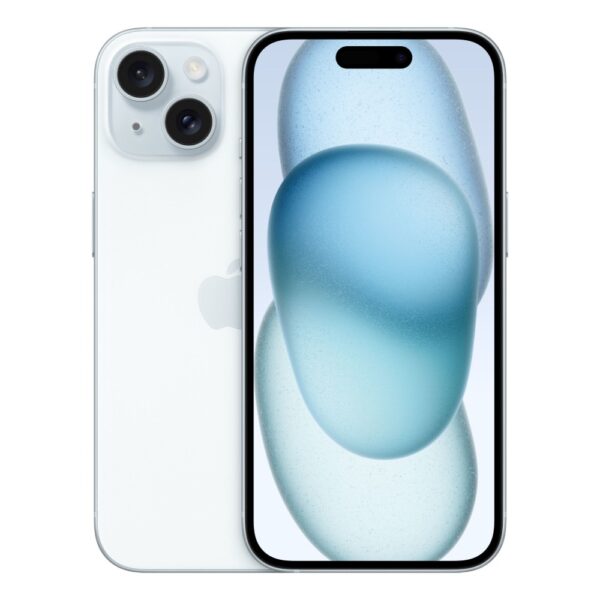
The iPhone 18 Pro's headline feature is a variable aperture on the main camera, and against an iPhone 17 Pro it buys you about half a stop of extra light. Apple's specifications put the 18 Pro's widest opening at f/1.48 and the 17 Pro's fixed opening at f/1.78. That is a gain of 0.53 of a stop. The bigger change is in the other direction: the new camera can close down to f/4.0, which the old one could not do at all.
What brought you here?
Apple announced the iPhone 18 Pro and iPhone 18 Pro Max on 10 September 2026, alongside its first foldable, the iPhone Duo. There is no standard iPhone 18 in the line-up yet. If you are comparing an iPhone 17 Pro against an iPhone 18 Pro, six things are different and most of them are small.
| iPhone 17 Pro | iPhone 18 Pro | |
|---|---|---|
| Chip | A19 Pro | A20 Pro, vapour cooled |
| Main camera | 48MP, fixed f/1.78 | 48MP, variable f/1.48 to f/4.0 |
| Video playback | up to 31 hours | up to 34 hours |
| Top storage | 1TB | 2TB |
| Neural Engine | 16 core | dual 16 core |
| Screen size | 6.3 inch | 6.3 inch, unchanged |
Everything else you touch every day is the same. Same 6.3 inch screen at the same 460 pixels per inch, same 120Hz ProMotion, same Always-On display, same aluminium unibody, same Ceramic Shield back, same IP68 rating to six metres for half an hour, same USB-C port. The 18 Pro is 211 grams and 8.75mm thick, and it is not a redesign.
So the decision comes down to the camera and the chip. Take the camera first, because it is the thing Apple led with.
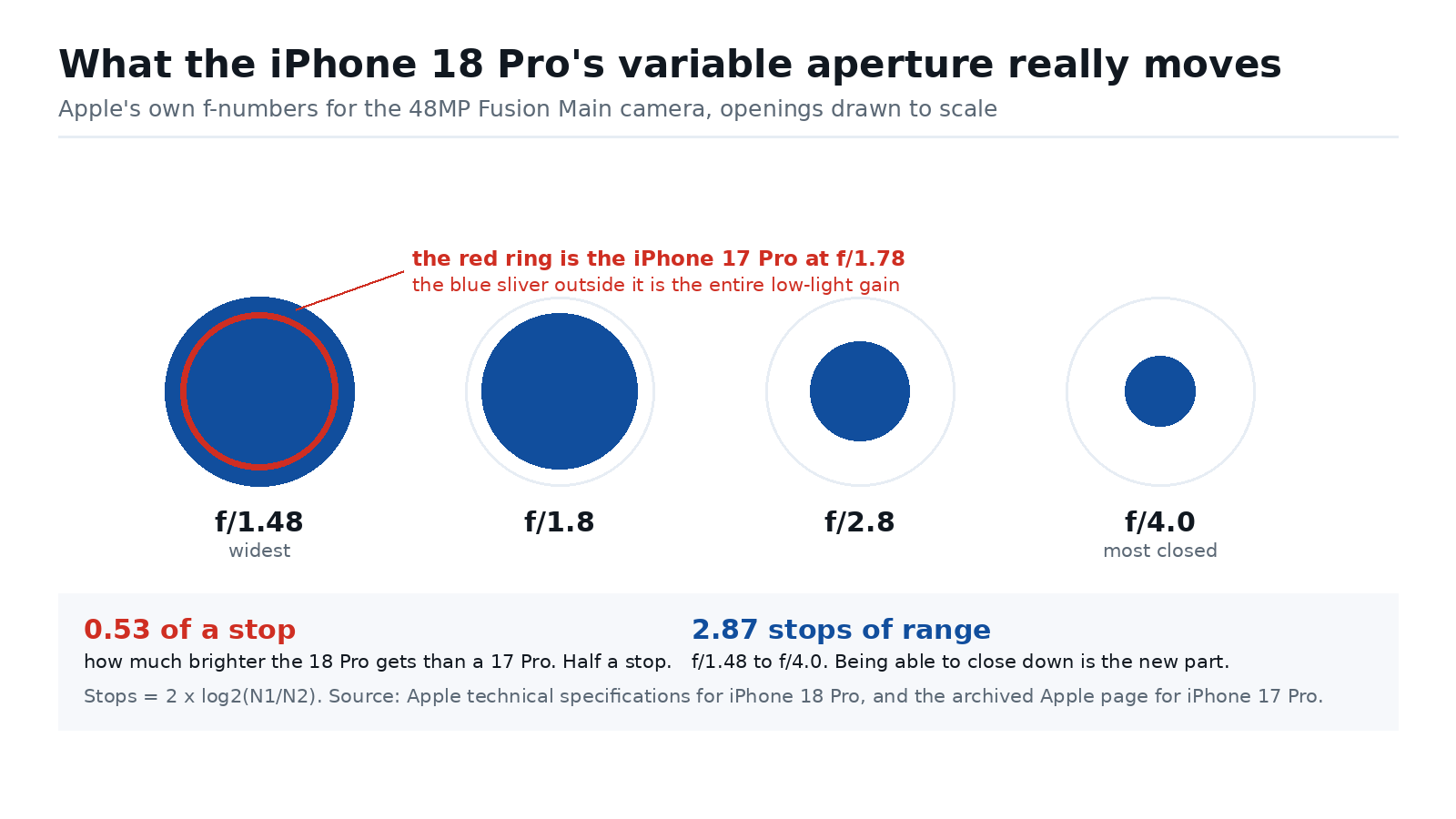
A variable aperture means the lens can change the size of its opening. Every iPhone before this one had a fixed opening on the main camera. Apple gives the iPhone 18 Pro four settings: f/1.48, f/1.8, f/2.8 and f/4.0.
Almost every write-up you will read frames this as a low-light feature. Do the arithmetic on Apple’s numbers and that framing does not survive.
The iPhone 17 Pro’s main camera is fixed at f/1.78. The iPhone 18 Pro opens to f/1.48. The gap between two f-numbers in stops is two times the base-2 logarithm of their ratio, which gives 0.53 of a stop. Half a stop. In practice that is the difference between a shutter speed of 1/60 and roughly 1/85. It is a real gain and it is not nothing, but it is not the transformation the word “variable” suggests.
The interesting end is the other one. Going from f/1.48 to f/4.0 is 2.87 stops of range, and closing down is something no previous iPhone main camera could do. Stopping down is not a brightness control, it is a depth-of-field control. It keeps more of a scene sharp from front to back, and it tames the blown highlights and flare you get shooting into a light source. If you photograph buildings, landscapes, flat artwork or anything where you want the whole frame crisp, that is the change worth having.
Apple also adds new Pro camera controls and Photographic Styles 3, which adjusts texture and grain.
One limit on all of this: nobody has used an iPhone 18 Pro long enough to publish a real-world comparison yet, ourselves included. The numbers above are geometry, not a review.
Both 18 Pro models carry the same three 48MP cameras, so the iPhone 18 Pro Max camera is not a different camera from the iPhone 18 Pro camera. You get the 48MP Fusion Main at 24mm with the variable aperture, a 48MP Fusion Ultra Wide at 13mm and f/2.2 with a 120 degree field of view, and a 48MP Fusion Telephoto at 100mm, f/2.8, built on a tetraprism with 3D sensor-shift stabilisation.
That telephoto is a 4x lens. Apple also lists a 12MP optical-quality 8x telephoto at 200mm, and the phrase “optical quality” is doing real work there. It is a crop from the middle of the 48MP telephoto sensor, not a fifth lens. You get 200mm of reach at 12MP rather than 48MP, and it is still f/2.8, so in poor light the 8x setting is asking a lot of the sensor.
There is a 2x setting at 48mm on the same principle, cropped from the main camera at 12MP. Between them you have 13mm, 24mm, 48mm, 100mm and 200mm without changing anything but the button you press.
If you are on a 17 Pro Max, the comparison is more favourable than the smaller pair, and the reason is battery.
Apple rates the iPhone 17 Pro Max at up to 37 hours of video playback and the iPhone 18 Pro Max at up to 43 hours. That is six extra hours. The smaller models gain three, from 31 to 34. So the Max picks up twice the improvement its sibling does, which is unusual and worth knowing if battery is the reason you are looking.
Physically the Max is 6.9 inches, 2868 by 1320 pixels, 249 grams, and 78mm wide. It is a large phone and Apple has not made it smaller. Storage now runs to 2TB, which is the other Max-flavoured change: if you shoot ProRes video, the top tier doubled.
Apple’s UK recommended prices start at £1,299 for the iPhone 18 Pro Max with 256GB and £1,199 for the iPhone 18 Pro. The full price ladder, including what each storage tier costs, is on our iPhone 18 release date and price page.
The A20 Pro is a 6-core processor with two performance cores and four efficiency cores, a 7-core graphics processor with Neural Accelerators, and hardware-accelerated ray tracing. Apple describes it as vapour cooled, which is a first for the phrase appearing in an iPhone specification.
The number that stands out is the dual 16-core Neural Engine. Apple has doubled the part of the chip that runs machine-learning work, and it says the chip is purpose-built for AI. In everyday terms that is the hardware behind on-device Apple Intelligence and Siri AI, and behind the camera processing that decides what a photo looks like before you ever see it.
What Apple does not publish is a clock speed or a benchmark, so anyone quoting you a percentage speed increase today is quoting Apple’s marketing comparison, not a measurement. Wait for independent testing before you treat a number as fact.
Apple publishes three battery figures for each model, and they are the ones to compare:
Charging is unchanged in shape: up to 50% in around 15 minutes, but only with a 60W-capable adapter that supports Adjustable Voltage Supply, and that adapter is sold separately. With a 35W adapter and a MagSafe charger you get 50% in 30 minutes instead.
The figure Apple does not publish is the one people search for: the capacity in mAh. Apple has never put milliamp hours on its specification pages, so if you see an iPhone 18 Pro battery mAh figure quoted today it has come from a teardown or a regulatory filing, not from Apple. Treat it accordingly until someone opens one.
Here is the part most comparisons will not say plainly.
If you have an iPhone 17 Pro or 17 Pro Max, skip it. You are paying for half a stop of extra light, a chip you cannot yet see the benefit of, and three extra hours of video. The screen, the body, the port and the build are the same. The exception is if you specifically want to stop the lens down for depth of field, or you need 2TB.
If you have an iPhone 15 Pro or older, this is a genuine generational jump. You are getting several years of camera, chip and battery work at once, and the variable aperture is a bonus rather than the reason.
If you are choosing between a 17 Pro and an 18 Pro today, and the 17 Pro has dropped in price, the 17 Pro is the better value on the numbers. You give up half a stop and gain a discount.
If you want a bigger screen rather than a better camera, the foldable iPhone Duo is now the other option in Apple’s line-up, and it is a different kind of phone rather than a better version of this one. Our iPhone Duo vs Pro Max comparison shows where its bigger screen helps and where it does not.
Worth listing, because the things that stayed the same are why the upgrade case is narrow:
Apple has also moved its own silicon further in: the N1 wireless networking chip and the C2 cellular modem are both Apple parts.
Apple sells the iPhone 18 Pro directly, and it has only just gone on sale. If the comparison above has pointed you at the previous generation instead, our Apple iPhone range is below, including the iPhone 17 Pro that this article recommends over the 18 Pro on value. Prices and availability on the cards come from the product pages, which are the only place that is always right.
If you are coming from an iPhone 17 Pro, on the published numbers it is hard to justify. The main gain is 0.53 of a stop of extra light on the main camera and three more hours of video playback, on the same screen and the same body. From an iPhone 15 Pro or older it is a straightforward yes, because you collect several generations of improvement at once.
Yes. Apple's technical specifications list the 48MP Fusion Main camera with four aperture settings: f/1.48, f/1.8, f/2.8 and f/4.0. It is the first iPhone main camera that can change its opening. The ultra wide stays fixed at f/2.2 and the telephoto at f/2.8.
On paper yes, but by less than the headlines suggest in low light. The widest opening moves from f/1.78 to f/1.48, which is about half a stop. The larger change is that the lens can now close down to f/4.0, which gives you depth-of-field control the older camera did not have. No independent real-world comparison exists yet.
The screen is the same at 6.3 inches, and the iPhone 18 Pro measures 71.9 by 150.0 by 8.75mm at 211 grams. The iPhone 18 Pro Max is 6.9 inches, 78.0 by 163.4 by 8.75mm, at 249 grams. Most 17 Pro cases will be close, but the camera plateau is the part to check before you assume a case fits.
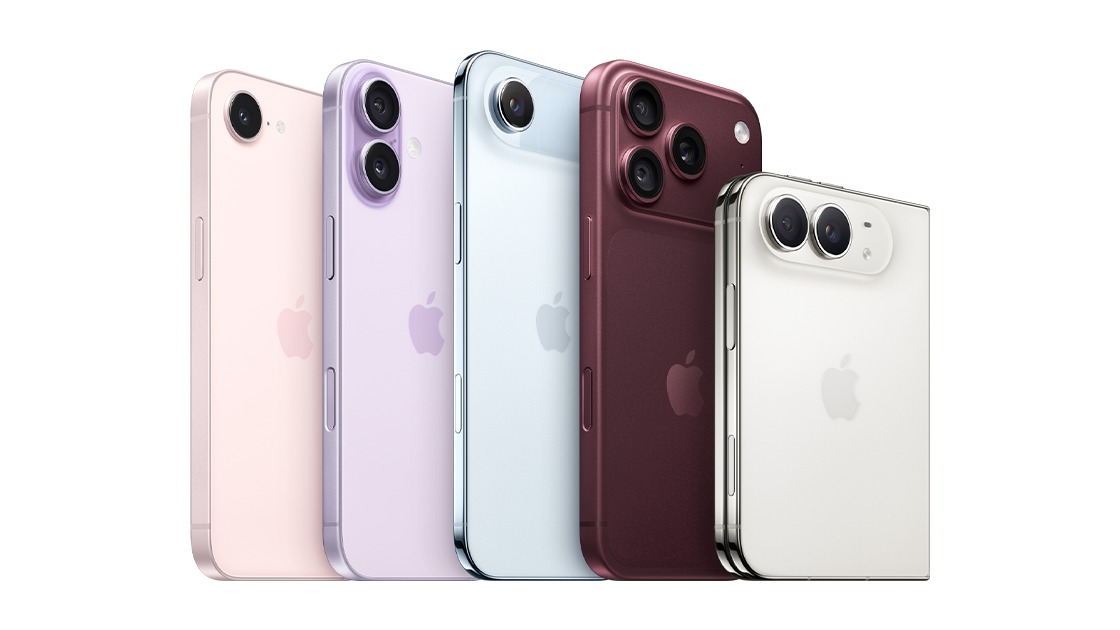
Between the Pro models the difference is narrow: the variable aperture camera, the A20 Pro chip with a dual 16-core Neural Engine, a 2TB storage tier and a few hours of battery. Note there is no standard iPhone 18 yet. Apple's current line-up runs iPhone Duo, iPhone 18 Pro and Pro Max, iPhone 17, iPhone 17e, iPhone Air and iPhone 16.
If the 17 Pro is discounted, it is the better value: you give up about half a stop of aperture and three hours of video playback. Buy the 18 Pro if you want to stop the lens down for depth of field, if you need the 2TB tier, or if you are keeping the phone long enough that the doubled Neural Engine matters.
The Hardvance Team is the editorial team at Hardvance, a UK computer and electronics retailer based in Mildenhall, Suffolk. We build and upgrade PCs and sell laptops, phones, networking gear, monitors and printers, and our guides cover the same ground. Every guide names its sources and explains how we checked the figures, and we say plainly when something is our opinion rather than a tested result.
View all posts by Hardvance Team


No account yet?
Create an Account