
The Price Gap Halved: Is the Steam Deck Still Worth It vs ROG Ally, Xbox Ally and Switch 2
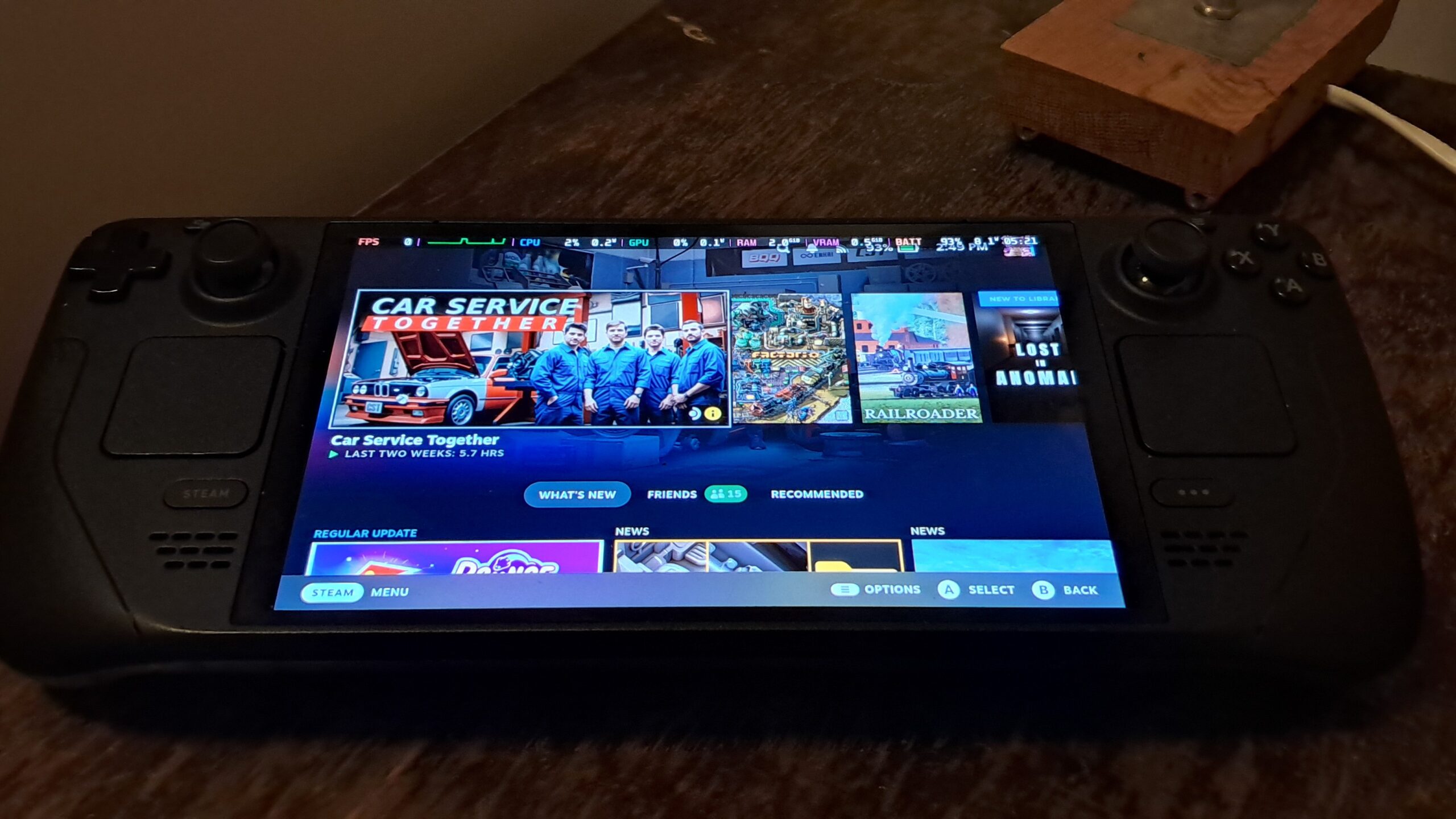
The Steam Deck was never the most powerful handheld. It was the cheap one that just worked. That is the part that changed in 2026, and Valve changed it: on 27 May Valve raised the Steam Deck OLED price and said in its own announcement that this was "due to rising memory and storage costs". The 512GB OLED went to $789, the 1TB to $949. So the question is no longer whether the Deck is good. It is whether it is still the obvious buy at its new price.
Find your situation:
- You mostly want it to just workSteamOS is still the reason to pick a Deck, and no Windows handheld matches it for that. The case for buying one
- You want the most framesThe Ally line wins on raw hardware and always did. The comparison
- You are looking at the Xbox oneIt is a Windows PC with an Xbox front end, not an Xbox. What that means
- You mostly play Nintendo gamesThen this was never really a contest. Switch 2 vs Steam Deck
- You are choosing a modelThe OLED is a bigger upgrade than the spec sheet suggests. OLED vs LCD
- You are tempted to waitValve has confirmed a successor and given no date at all. What Valve actually said
The short version: the Deck is still the best handheld for someone who wants a console experience, and it is no longer the budget option. Those two things are now both true at once, which is why the advice has got harder.
Is the Steam Deck worth it in 2026
Is a Steam Deck worth it at the new price, which is how most people are now asking it? Yes, but for a narrower reason than it used to be, and you should know what that reason is before you spend.
Here is what moved. On 27 May 2026 Valve posted an announcement titled “Steam Deck back in stock, with updated pricing”. The opening line is blunt: “Steam Deck OLED is back in stock, with a price increase for both models due to rising memory and storage costs.” The new prices, including VAT where it applies:
- Steam Deck OLED 512GB: $789 USD, EUR 779, GBP 649, CAD 1,129, AUD 1,199
- Steam Deck OLED 1TB: $949 USD, EUR 919, GBP 779, CAD 1,349, AUD 1,429
Valve added a line worth reading twice: “Steam Deck itself hasn’t changed; these new prices reflect the current state of component costs and other global logistical challenges across the industry as a whole.”
That is the whole story in one sentence. The hardware did not get better. The memory inside it got more expensive, for the same reason your next RAM upgrade did, which we covered when we looked at the 2026 console price increases.
So who should still buy one
Buy a Steam Deck if you want a games console that happens to run PC games. SteamOS boots into a game library, suspends and resumes a game like a console does, and does not ask you to fight Windows on a 7 inch screen. Nothing else in this category does that as well, and that gap has not closed at all.
Think harder if you want the most performance per pound. On raw hardware the Deck was behind the Ally line before the price rise, and it is behind at a smaller discount now.
What are the downsides of a Steam Deck
- The screen is 1280×800. That goes for both the LCD and the OLED. It is a deliberate choice that helps frame rates, and it is lower than the 1080p panels the competition ships.
- The chip is from 2022. Valve lists a Zen 2 CPU and 8 RDNA 2 compute units in both models. The OLED moved to a 6nm process and faster memory, not to a new architecture.
- Not every game runs. Anti-cheat is the usual blocker. Check Deck Verified before you count on a specific game. GTA 6 is the obvious example: it is not even on PC yet, so there is no word on GTA 6 for Steam and Steam Deck.
- It is no longer cheap. See above.
Steam Deck vs ROG Ally
Steam Deck vs ROG Ally has always been the same trade, and the trade is software against hardware. What changed in 2026 is the price gap, not the trade.
Take the two makers’ own figures. Valve lists the Steam Deck OLED with a Zen 2 four core, eight thread CPU running 2.4 to 3.5GHz, 8 RDNA 2 compute units at 1.6GHz, a 4 to 15W power envelope, and 16GB of LPDDR5 at 6400 MT/s. Asus lists the ROG Xbox Ally X with a Ryzen AI Z2 Extreme, eight cores and sixteen threads, 2.0GHz base and up to 5.0GHz, and 24GB of LPDDR5X in dual channel.
That is not a close fight on paper and nobody pretends it is. The Ally line has more CPU, more memory and a higher resolution screen. Asus lists a 7 inch 1920×1080 panel at 120Hz and 500 nits against Valve’s 1280×800.
ROG Ally vs Steam Deck on the things you notice
ROG Ally vs Steam Deck stops being one sided the moment you stop reading spec sheets.
- Screen quality, not screen numbers. Valve’s OLED panel is 1,000 nits peak in HDR, 600 in SDR, with a contrast ratio it puts at over 1,000,000 to 1 and 110% of P3. Asus lists 500 nits on an IPS-level panel. The Deck has fewer pixels and a visibly better picture.
- Weight. Valve lists roughly 640 grams. Asus lists 715 grams for the Xbox Ally X. You feel 75 grams at hour two.
- Battery. Asus lists an 80Whr cell against Valve’s 50Whr, and that is a real advantage to the Ally. Valve quotes 3 to 12 hours of gameplay and is clear that it depends on the game.
- The operating system. SteamOS 3 is Arch Linux with a console front end and a proper KDE Plasma desktop behind it. The Ally runs Windows 11 Home. One of those was designed for a gamepad.
Steam Deck vs ROG Ally X specifically, or ROG Ally X vs Steam Deck OLED if you prefer it that way round, is the sharpest version of this: the best screen against the best hardware.
ROG Xbox Ally vs Steam Deck
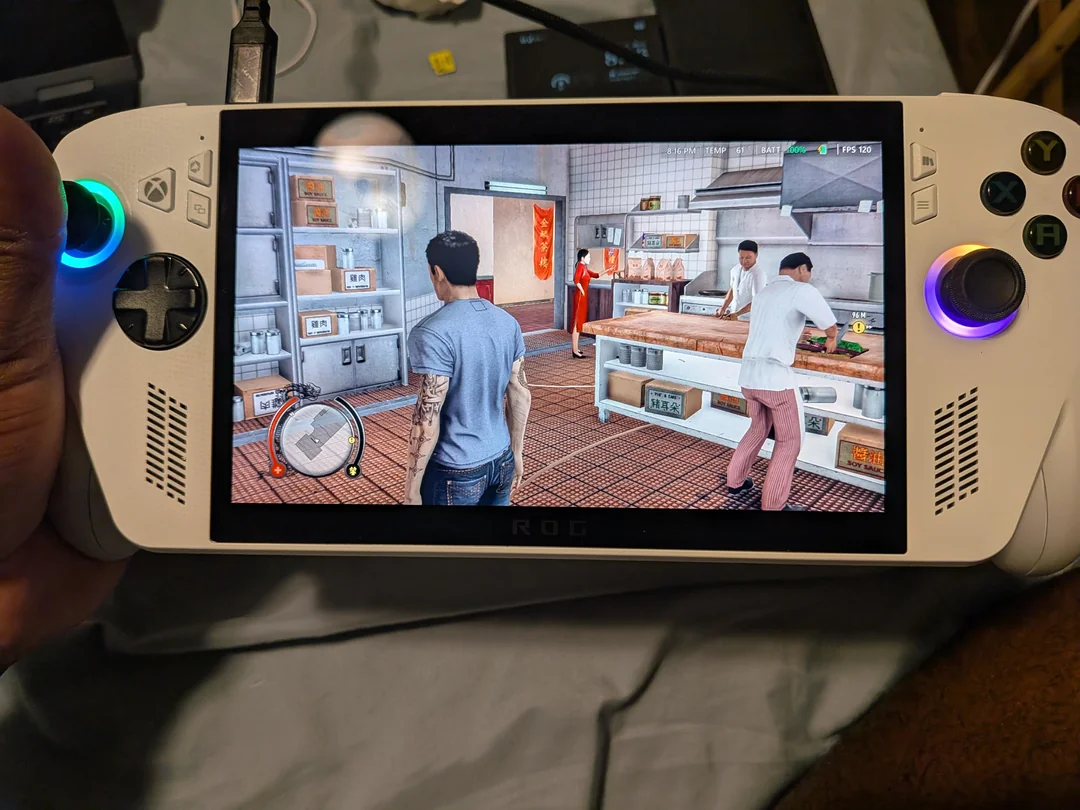
ROG Xbox Ally vs Steam Deck is the comparison people are actually running in 2026, because the Xbox branding makes it look like a console fight. It is not one, and the difference matters before you spend.
The ROG Xbox Ally X runs Windows 11 Home. What Microsoft added is the Xbox Full Screen Experience, a console-style front end that launches instead of the Windows desktop, plus grips shaped like an Xbox controller. Microsoft describes it as “the Xbox experience and the freedom of Windows in your hands”.
So what does it play? Microsoft lists Xbox Play Anywhere titles you already own, Game Pass, and games from Windows PC storefronts, “playing locally or streaming from your console or the cloud”. Read that carefully. Local play means PC versions. Console games reach it by streaming, from your own Xbox or from the cloud.
That is the right frame for a Steam Deck comparison. Both machines are PCs. One puts a Steam front end on Linux, the other puts an Xbox front end on Windows. Neither is a console, and neither plays console discs.
Why is the Xbox ROG Ally X so expensive
Because it is a high-end handheld PC and it was priced as one. Microsoft and Asus launched it on 16 October 2025 at an estimated retail price of $999.99. It is the same memory market that pushed the Deck up, applied to a machine with 24GB of LPDDR5X and a 1TB drive.
Here is the number that matters for your decision. Valve launched the Steam Deck OLED on 16 November 2023 at $549 for the 512GB and $649 for the 1TB, the prices reported across the coverage at the time and recorded in the model’s price history. Against $999.99 for the Xbox Ally X, that was a gap of roughly $450. Valve’s May 2026 increase took the 512GB Deck to $789, so the gap is now about $210. It has roughly halved. The Deck is still cheaper. It is no longer close to half the price.
Switch 2 vs Steam Deck
Switch 2 vs Steam Deck looks like a handheld comparison and is really a library comparison. Work out which games you want first and the hardware argument mostly answers itself.
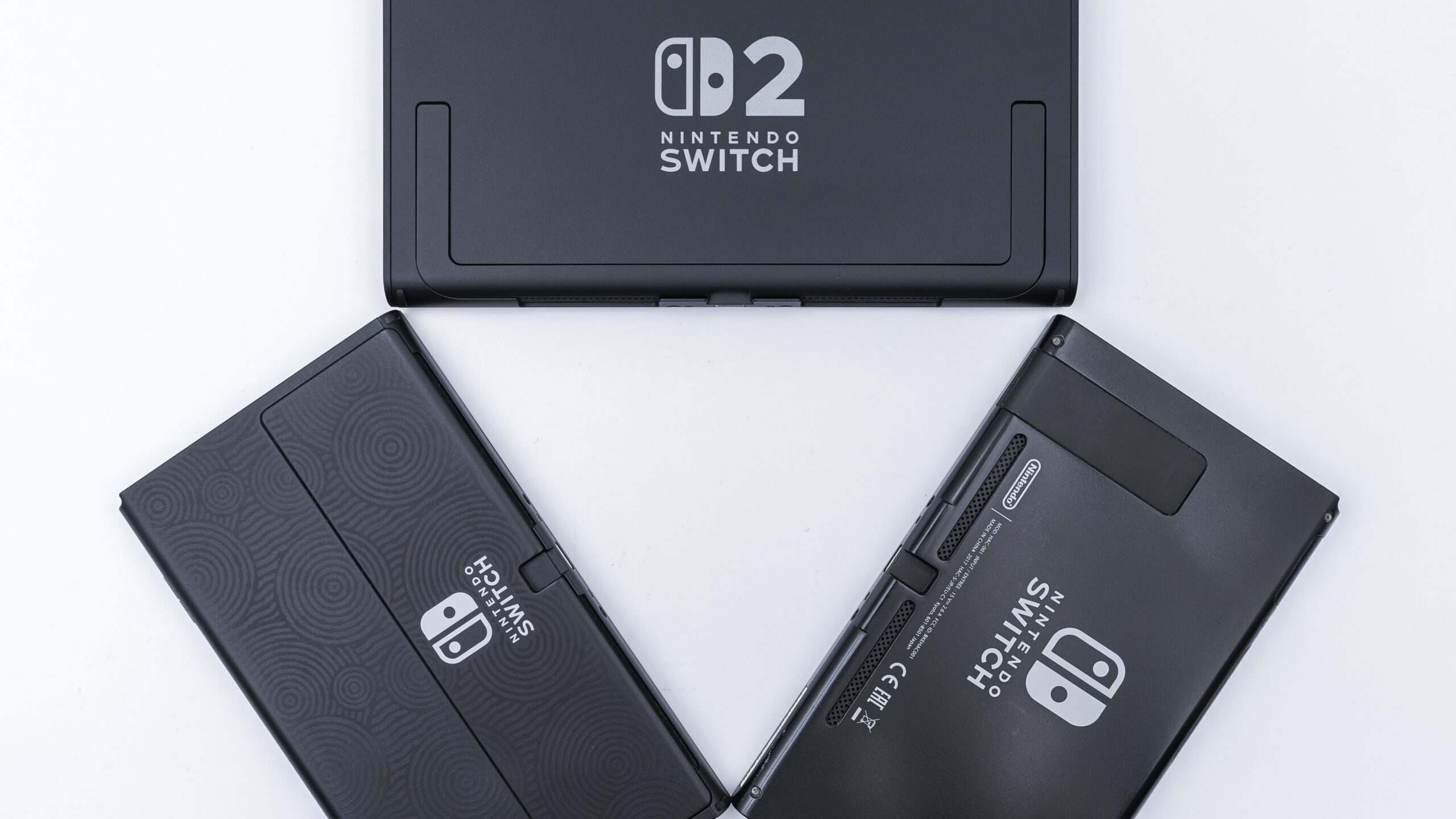
The Switch 2 has a 7.9 inch wide colour gamut LCD at 1920×1080, with HDR10 and variable refresh rate up to 120Hz. Storage is 256GB of UFS. The battery is 5172 mAh in the user-replaceable version, and Nintendo puts battery life at roughly 2 to 6.5 hours. Docked, it outputs up to 3840×2160 at 60fps, or 120fps at 1080p and 1440p.
It is also much lighter. Nintendo lists roughly 401 to 441 grams for the console, or 534 to 548 grams with the controllers attached, against about 640 grams for the Steam Deck OLED.
Steam Deck vs Switch 2 for the games you actually play
Steam Deck vs Switch 2 comes down to three questions, and none of them is about teraflops.
- Do you want Nintendo games? Mario, Zelda and Pokemon exist on exactly one of these machines, and no amount of Linux tinkering changes that legally.
- Do you already own a Steam library? If you have hundreds of PC games, the Deck plays them at no extra cost. That is often the whole argument.
- Who else is playing? The Switch 2 detaches its controllers and hands one to someone else. The Deck does not.
Is Switch better than Steam Deck? For handheld Nintendo games and for two people on a sofa, yes. For a PC library and for tinkering, no. They are less rivals than people assume.
Steam Deck OLED vs LCD
Steam Deck OLED vs LCD is the easiest decision on this page, and the spec sheet undersells it, because the OLED revision changed far more than the panel.
The differences:
- Screen. LCD: 7 inch, 1280×800, 400 nits, 60Hz. OLED: 7.4 inch, same 1280×800, HDR OLED, 1,000 nits peak HDR and 600 SDR, over 1,000,000 to 1 contrast, 110% P3, up to 90Hz.
- Chip. LCD: 7nm APU. OLED: 6nm APU. Same Zen 2 cores and same 8 RDNA 2 compute units, on a more efficient process.
- Memory. 16GB LPDDR5 on both, but 5500 MT/s on the LCD against 6400 MT/s on the OLED.
- Battery. 40Whr and 2 to 8 hours on the LCD, 50Whr and 3 to 12 hours on the OLED.
- Wireless. Wi-Fi 5 on the LCD, Wi-Fi 6E and Bluetooth 5.3 on the OLED.
Steam Deck LCD vs OLED, now the prices have moved
Steam Deck LCD vs OLED used to be a genuine budget decision. The OLED is the one Valve raised the price on and the one it describes as back in stock, and it is the model the company clearly treats as the current Deck.
Our read: if you are buying a Deck at all in 2026, buy the OLED. A bigger battery and a much better screen are worth more day to day than the extra storage, and the LCD’s smaller, dimmer 60Hz panel is the part of the older model you would notice every session.
Steam Deck 2: what Valve has actually said
Steam Deck 2 is the reason a lot of people are hesitating, so here is what Valve has said rather than what the rumour mill has. There is no Steam Deck 2 release date. Not a delayed one, not a rumoured window Valve has blessed. None.
IGN put it to Valve’s Pierre-Loup Griffais, in an interview published in September 2026, that the current hardware shortage might have changed how Valve is thinking about putting a Steam Deck 2 into development. His answer, verbatim:
“Not really. I think the same way that we’re working back from the user experience and what we’re bringing to the table in terms of the same things that we’ve talked about before about how we want to make sure there’s a very delineated performance improvement for something like a future Steam Deck, I think we’re still looking at it in the same way. It’s just a matter of looking at the current conditions and seeing how and when we can deliver something like that.”
Three things are in that answer, and all three are useful.
- A successor is real. Valve is talking about it in the present tense, not denying it.
- Valve will not ship a small upgrade. The phrase is “a very delineated performance improvement”. That rules out a modest refresh of the current chip.
- There is no date. “How and when we can deliver something like that” is not a timeline. Valve has given no release window, no price and no specifications.
Set that against the memory market. A handheld whose price already rose because of memory costs is not an easy thing to replace with a much faster machine, and Griffais points straight at “the current conditions”. Waiting is a reasonable choice if you are happy with what you have. Waiting with no announced date, in a market where prices have gone up rather than down, is a different bet.
Steam Deck alternative options, and the best handheld gaming console for each kind of player
The best Steam Deck alternative is easy to find and hard to choose, because the category has split into four kinds of machine that suit four different people. There is no single best gaming handheld, and the round-ups promising the best handheld gaming consoles are usually ranking four different products against each other. Which is the best gaming handheld 2026 can offer you depends on a question those lists skip: what do you want it to feel like?
If you want a console that plays PC games
The Steam Deck, and it is not close. SteamOS is the product. The Legion Go S is the interesting case here, because Lenovo ships a version with SteamOS rather than Windows, which is why Legion Go S vs Steam Deck comes up so often. That is the first serious attempt by another maker to compete on Valve’s actual advantage instead of around it.
If you want the most performance
The ROG Ally line, and the ROG Xbox Ally X at the top of it. These are the machines people mean by the best handheld gaming pcs, as opposed to handheld consoles. You are buying Windows and everything that comes with it, good and bad, plus the best hardware in the category. Asus ROG Ally vs Steam Deck is the older version of the same comparison and it lands the same way.
If you want Nintendo games
The Switch 2. See above. This is a library decision.
If you want cheap and cheerful, or old games
This is a different search entirely. The best retro gaming handheld, or the best handheld for retro gaming, is not the same product as a Steam Deck, and it is usually a cheap Android device rather than anything else on this page. They have improved fast, which is why Ayn Thor vs Steam Deck is a real comparison now rather than a joke. The best android gaming handheld will not run your Steam library natively. It will emulate a great deal and cost much less.
So what is the best handheld gaming console has four legitimate answers, and which one is yours depends on the list above rather than on a spec sheet. Pick the operating system first, the chip second.
Best handheld gaming PC or a handheld console
Searches for the best handheld gaming PC, the best handheld gaming devices and the best handheld gaming systems all land on the same list of machines, and that is the source of a lot of confusion. A handheld PC and a handheld console are not the same question.
A handheld gaming PC is a computer. The Steam Deck and the ROG Ally are both PCs. You can install other launchers, plug in a monitor and a keyboard, and use it as a desktop. The Deck ships a KDE Plasma desktop for exactly that. You also inherit PC problems: driver updates, settings, and games that will not launch.
A handheld console is a closed appliance. The Switch 2 is one. You get certainty in exchange for control. Every game is tested on the hardware, nothing needs configuring, and you cannot install anything the platform holder has not approved.
Steam Deck vs Steam Machine is the same split in a different box, and we went through that one in detail when we costed a Steam Machine against building a PC. The Steam Deck sits deliberately between the two and that is the clever part of it. It behaves like a console until you want it to behave like a PC. If that is what you want, the price rise has made it more expensive but it has not produced a replacement. Valve’s new VR headset is not one either: it can play flat Steam games on a giant virtual screen, but Steam Frame battery life is about an hour when it runs games on its own.
If you are also weighing up a desktop or laptop for the same money, our gaming PC buying guide and our gaming laptop guide cover what the same budget buys when you are not carrying it around.
Quick answers
Yes, if you want a console-like machine that plays PC games. SteamOS is still the reason to choose one and nothing else in the category matches it. What has changed is the price: Valve raised the Steam Deck OLED on 27 May 2026 to $789 for the 512GB and $949 for the 1TB, saying in its own announcement that this was due to rising memory and storage costs. It is still the cheapest way into this category. It is no longer a bargain.
Is Steam Deck worth it is really two questions. The hardware answer has not changed since launch, because the hardware has not changed: Valve lists the same Zen 2 CPU and 8 RDNA 2 compute units on both models. The value answer has changed, because the price went up while the specification stayed still. Buy it for SteamOS and the screen on the OLED model, not for frames per pound.
A 1280x800 screen, which is lower than the 1080p panels rivals ship. A CPU architecture from 2022. Games that refuse to run, usually because of anti-cheat rather than performance. And a price that rose sharply in May 2026. Against that you get the best handheld operating system in the category and, on the OLED, the best screen.
They are not. Valve was selling Steam Deck OLED models when it announced the May 2026 price increase, titled "Steam Deck back in stock", and its own developer has since confirmed to IGN that a future Steam Deck is still being worked on. What feeds this idea is the age of the chip and the lack of a successor date, which is a different thing from a product being discontinued.
On raw hardware, yes. Asus lists the ROG Xbox Ally X with an eight core Ryzen AI Z2 Extreme, 24GB of LPDDR5X and a 1080p 120Hz screen, all ahead of the Deck. On the experience of picking it up and playing, the Deck is still the one to beat, because SteamOS was built for a gamepad and Windows was not. Better depends entirely on which of those you care about.
Valve has confirmed it is working on a future Steam Deck but has given no date, no price and no specifications. Asked by IGN in September 2026 whether the hardware shortage had changed its thinking, Valve's Pierre-Loup Griffais said "Not really", adding that Valve wants "a very delineated performance improvement" and that it is "a matter of looking at the current conditions and seeing how and when we can deliver something like that".
The silicon is ageing, and Valve has not refreshed it. The OLED revision moved to a 6nm process and faster memory but kept the same Zen 2 cores and the same 8 RDNA 2 compute units. Whether that matters depends on what you play: it is still comfortable with most of a back catalogue at 800p, and it was never aimed at the newest releases at high settings.
For Nintendo games, obviously, because they are not legally available anywhere else. For handing a controller to someone else, yes, because the Joy-Con detach. For playing a PC library you already own, no. Nintendo also lists the Switch 2 at roughly 401 to 441 grams against about 640 grams for the Steam Deck OLED, which you notice in bed.
The Steam Deck is larger and heavier but shaped like a controller, with full-size grips and two trackpads. The Switch 2 is a flat slab with detachable controllers and is much lighter. People with big hands usually prefer the Deck despite the weight; people playing in bed usually prefer the Switch 2 because of it. Both are personal enough that trying them beats reading about them.
Microsoft and Asus launched the ROG Xbox Ally X on 16 October 2025 at an estimated retail price of $999.99, with regional prices set locally. That is roughly $210 above the current $789 Steam Deck OLED 512GB, where the gap used to be around $450 before Valve's price increase.
If you want the fastest handheld and you are comfortable with Windows, it is the strongest hardware here: Asus lists an eight core, sixteen thread Ryzen AI Z2 Extreme, 24GB of LPDDR5X, a 1TB PCIe 4.0 drive and an 80Whr battery. If you want something that behaves like a console, the extra money is buying you power you will spend some of your time fighting an operating system to use.
Not natively, because it is a Windows PC rather than an Xbox console. Microsoft describes it as playing Xbox Play Anywhere titles you own, Game Pass, and games from Windows PC storefronts, "playing locally or streaming from your console or the cloud". So console-only games reach it by streaming from your own Xbox or from the cloud, not by running on it.
It is a high-specification handheld PC with 24GB of LPDDR5X and a 1TB NVMe drive, launched at $999.99, and it is sold into the same memory market that pushed the Steam Deck up. Valve blamed its own increase on "rising memory and storage costs". The same pressure sits underneath every machine on this page.
Sources
- Valve: Steam Deck back in stock, with updated pricing, 27 May 2026. The source for the price increase, the quoted reason, and the $789 and $949 figures.
- Valve: Steam Deck OLED tech specs and Steam Deck LCD tech specs. Panel, APU, memory, battery and weight figures.
- Asus: ROG Xbox Ally X full specification. Processor, NPU, 24GB LPDDR5X, display, 80Whr battery, 715g and Windows 11 Home.
- Nintendo UK: Nintendo Switch 2 specifications. Screen, storage, battery capacity and life, weight and docked output.
- IGN: Steam Frame, the Valve interview. The source for the Griffais quote on Steam Deck 2 and the hardware shortage.
- Xbox Wire: ROG Xbox Ally and ROG Xbox Ally X now available worldwide. What the machine plays, and the Xbox Full Screen Experience.
- Wikipedia: Steam Deck, used only for the model price history, including that Valve "increased the prices for both the 512GB and 1TB OLED models to $789 and $949 respectively" on 27 May 2026.
- Xbox Wire: pre-orders open for ROG Xbox Ally X and ROG Xbox Ally. The $999.99 estimated retail price and the 16 October 2025 launch.
- Xbox, PS5 and Switch 2 price increases, our own reporting on the memory shortage behind console pricing.
About Hardvance Team
The Hardvance Team is the editorial team at Hardvance, a UK computer and electronics retailer based in Mildenhall, Suffolk. We build and upgrade PCs and sell laptops, phones, networking gear, monitors and printers, and our guides cover the same ground. Every guide names its sources and explains how we checked the figures, and we say plainly when something is our opinion rather than a tested result.
View all posts by Hardvance Team